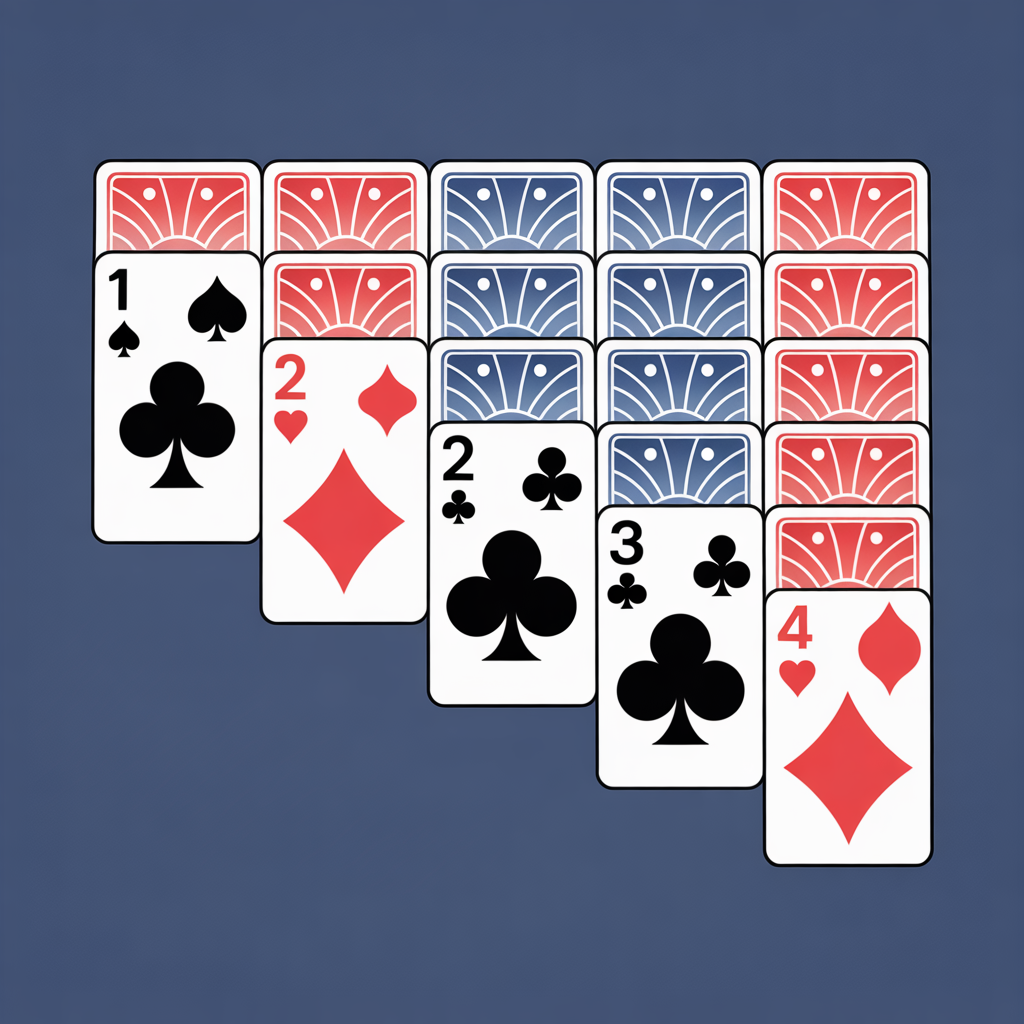
The Illusion of Graduated Difficulty
If you've spent time on solitairex.io, you've likely noticed the three Spider Solitaire difficulty options: 1-suit, 2-suit, and 4-suit. The conventional wisdom treats these as a simple volume dial—more suits, harder game, same core strategy. That assumption is wrong, and it's why thousands of players experience a sudden, demoralizing plateau when they step from 1-suit to 2-suit.
The truth: these aren't variants of the same game. They're three categorically different strategic problems wearing the same interface.
The 1-Suit Bottleneck: Column Management as the True Challenge
Let's establish a baseline. In 1-suit Spider, every card sequences naturally by rank—King through Ace in descending order. Sequencing constraint is zero. You will never fail a 1-suit game because you couldn't sequence; you'll fail because you ran out of moves due to poor column management.
Example position (1-suit): Imagine a tableau where Column 3 contains: K♠ Q♠ J♠ 10♠ 9♠ 8♠, and Column 7 contains only a 7♠ sitting on top of a face-down card. You have several unblocking moves available elsewhere. The decision isn't "can I sequence these?"—it's should you move that 8♠ off Column 3 to Column 7, knowing it will block access to the face-down card beneath 7♠?
This is pure operational optimization. The cognitive load centers on:
- Forecasting which columns will become dead zones
- Timing the emptying of columns to maintain "clearing paths"
- Avoiding premature column consolidation that wastes King landing space
Winning 1-suit players develop strong intuition here. They learn to recognize unblocking patterns, they sense when a position is "locked," and they build deep pattern-matching skills around column geometry.
But none of this directly transfers to 2-suit.
The 2-Suit Shock: Where Sequencing Becomes a Real Constraint
Add a second suit, and something fundamental shifts. You can no longer assume every card will fit into an existing sequence. A sequence of hearts breaks when you need to place a spade on top of a heart. Now sequencing is constrained.
Here's what's unintuitive: this doesn't just make the game "harder." It creates an entirely new category of decision-making that 1-suit players haven't practiced.
Example position (2-suit): Tableau state: Column 2 has K♥ Q♥ J♥ 10♥. Column 5 has K♠. Your stock still has cards. You can move the 10♥ to K♠, creating a mixed suit sequence. Should you?
In 1-suit, this question doesn't exist. In 2-suit, it's the central question of the game. Moving the 10♥ onto K♠ accomplishes:
- Unblocks Column 2 (good)
- Creates a mixed sequence you'll need to separate later (cost)
- Uses up K♠ as a landing spot for future sequences (cost)
Winning 2-suit play requires a mental model of separability: tracking which cards you're pairing together temporarily, and forecasting the cost of untangling them. This is a new cognitive apparatus.
Why 1-Suit Experts Plateau on 2-Suit
The plateau happens because 1-suit excellence trains your intuition in the opposite direction of what 2-suit demands.
In 1-suit, aggressive consolidation is often rewarded. Combining sequences early, emptying columns, maintaining options—these are virtues. Your heuristics lean toward "collapse partial sequences, unlock columns, keep the board open."
In 2-suit, premature consolidation becomes a trap. Merging a 9♥ sequence with a 10♠ sequence might create a 10-card mixed run, but it locks you into separating that run before you can build anything on it. Advanced 2-suit play requires patient fragmentation—building multiple isolated sequences in different columns, accepting a visually cluttered board.
A 1-suit expert sits down with 2-suit expecting their column-management intuition to carry them. It doesn't. They experience loss after loss, often with the sensation that they're "making stupid moves"—when actually they're making 1-suit-optimal moves in a game where 1-suit optimization is suboptimal.
The 4-Suit Cognitive Leap: Combinatorial Lookahead
4-suit Spider introduces a third catastrophic constraint: you now have four color/suit combinations to track. The number of "valid" moves increases, but the number of winning moves in any position collapses.
Example position (4-suit): Tableau with K♣ K♦ K♥ K♠ in different columns. Stock has 10 cards left. You have a sequence of 6 cards in Column 1 (mixed suits). Do you:
- Build a full King-to-Ace sequence first, clearing it?
- Interrupt and pursue one of the other Kings?
- Deal from stock first to access buried cards?
In 1-suit, you'd deal stock when columns lock. In 2-suit, you'd plan around suit alternation. In 4-suit, the decision tree explodes. You're mentally simulating 8–10 moves ahead, modeling the stock depletion, and evaluating the combinatorial cost of each path.
Winning 4-suit players report thinking in terms of:
- Sequence efficiency: What's the minimum number of moves to expose that card buried two sequences down?
- King scarcity: With four Kings in play, you can't waste them. Empty columns are precious, so the opportunity cost of using a King landing space is extreme.
- Stock timing: Dealing stock is a pivot point. You commit to a new set of constraints the moment cards flip. Advanced players model how stock deals will partition the remaining card space.
The Cognitive Architecture of Each Tier
Framed as mental models:
1-Suit: Single-variable optimization. How do I arrange these columns to avoid lockup? (Graph theory: path planning)
2-Suit: Constraint satisfaction + sequencing. Which temporary pairings do I accept, and which do I avoid? (Logic: satisfiability with soft constraints)
4-Suit: Bounded lookahead search. Which sequence of moves maximizes my optionality in the next 8–10 positions? (Combinatorics: tree search with pruning)
Practical Implications for Your Play
If you're a 1-suit player looking to crack 2-suit, deliberately unlearn aggressive consolidation. Practice building multiple partial sequences in parallel, even when it feels messy. The aesthetic of a "good position" in 2-suit looks chaotic to 1-suit eyes.
If you're moving to 4-suit, abandon the heuristic intuition that got you far in 2-suit. Start writing down the state after each move. Trace three possible sequences forward. 4-suit rewards explicit lookahead over felt experience.
As of June 2026, solitairex.io's tier system is one of the few interfaces designs that accidentally teaches this progression. Most online implementations blur these distinctions with inconsistent algorithms. The platform's clean separation is a feature—if you use it as a tool for cognitive progression rather than a difficulty slider.
The Deeper Lesson
Spider Solitaire's tiers reveal something about skill transfer: mastery of a constrained problem often requires unlearning. The intuitions that make you excellent at managing two dozen possibilities become liabilities when you're managing two thousand.
The player who dominates 1-suit but struggles on 2-suit isn't playing worse. They're playing a different game and haven't yet recognized it. The moment they do—the moment they stop expecting their 1-suit heuristics to port over—their win rate begins to climb.
That's the real difficulty curve in Spider Solitaire. It's not the suits. It's the willingness to think differently.