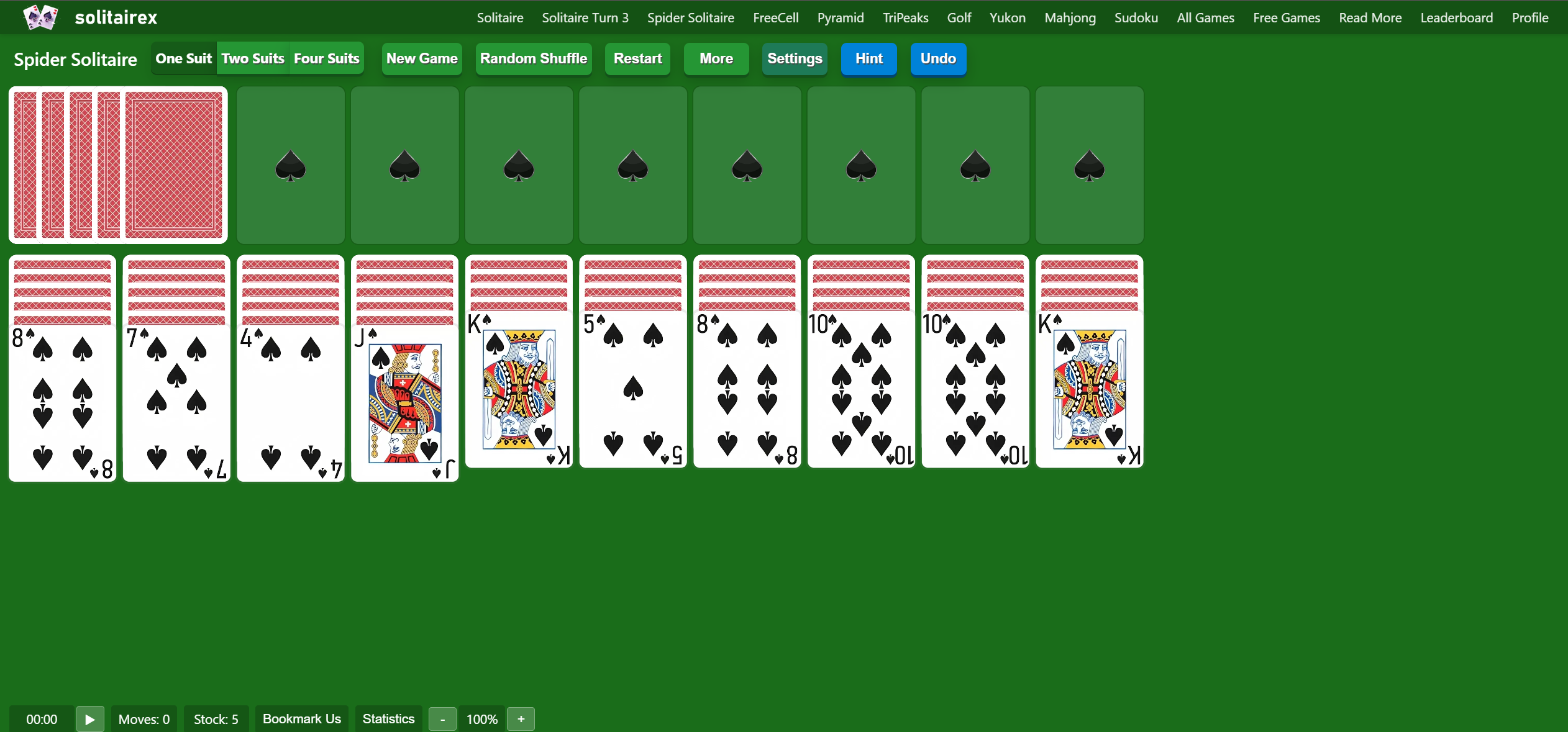
Spider Solitaire is a popular two-deck solitaire game known for its engaging challenge and multiple difficulty settings. Players can choose to play with one suit, two suits, or four suits, and this choice dramatically affects the game’s complexity and difficulty. In this blog post, we will explore the differences between Spider Solitaire 1-suit, 2-suit, and 4-suit games. We’ll compare how each variant plays, how much skill and time they typically require, and even who tends to enjoy each level of challenge. All statistics and insights are based on SolitaireX.io’s expertise and first-party data, ensuring the information is evidence-based and up-to-date.
Introduction to Spider Solitaire and Its Suit Variations
Spider Solitaire is often considered one of the most challenging solitaire (patience) card games, using two full decks (104 cards) and requiring the player to form eight sequences of cards in descending order (King down to Ace) to win. What makes Spider unique is the option to adjust the number of suits in play as a built-in difficulty level. A one-suit game uses 104 cards of the same suit (commonly all Spades), making every card compatible with every sequence. A two-suit game (usually Hearts and Spades) adds a moderate level of difficulty by introducing another suit to manage. Finally, a four-suit game uses all four suits (Spades, Hearts, Diamonds, Clubs), representing the classic, full challenge of Spider Solitaire. These variations essentially let players choose Easy, Medium, or Hard mode for Spider Solitaire.
Despite identical basic rules, the experience of playing Spider Solitaire differs greatly across 1-suit, 2-suit, and spider solitaire 4 suit games. The number of suits impacts how you build sequences, the likelihood of completing a game, and the strategies needed. It also influences how long a typical game might last and which players are most drawn to each variant. Below, we break down each version and highlight key differences in gameplay complexity, win rates, required skill, and popularity among different age groups.
Spider Solitaire’s difficulty can be adjusted by choosing 1, 2, or 4 suits. The fewer the suits in play, the simpler the gameplay. Here two friends enjoy a casual round of cards - a relaxed scenario akin to a 1-suit or 2-suit Spider game, which offers a gentler challenge for beginners and casual players.
Spider Solitaire (One Suit) - Beginner-Friendly and Quick
Gameplay and Rules: In the one-suit version of Spider Solitaire, all cards in the double deck are of the same suit (for example, every card is treated as a Spade). This simplification means suit matching is never a concern - any descending sequence of cards you build is automatically “in-suit.” You still deal 10 tableau columns and aim to assemble eight full runs from King down to Ace, but because there’s no suit variety, every valid move contributes directly toward forming a sequence. Essentially, one-suit Spider is all about ordering the ranks, without the extra layer of sorting by suit. This makes it far more forgiving: you can move sequences around freely and once you arrange a run K-Q-J-…-A in descending order, it’s guaranteed to be a complete suited sequence ready to clear.
Difficulty and Skill Required: One-suit Spider Solitaire is widely regarded as the easiest variation of the game. Luck in dealing plays a role, but skill-wise it requires much less planning than the higher-suit games. Because you don’t need to worry about matching suits, the game is straightforward to win with basic strategy and patience. In fact, SolitaireX’s data shows that the win rate for 1-suit Spider is very high - often between 70% and 84% for typical players. This means the vast majority of deals are winnable, and even relatively new players can expect to succeed frequently. One-suit games also tend to resolve faster than multi-suit games. Skilled players can sometimes finish a one-suit game in just 5-10 minutes since there are fewer obstacles; even casual players find that one-suit games rarely stretch beyond a quick session. The focus is on basic card maneuvering and uncovering hidden cards, making it an excellent way to learn Spider’s mechanics or enjoy a low-stress round.
Who Enjoys One-Suit Spider: Due to its accessible nature, the single-suit variant is popular among beginners and those looking for a relaxing solitaire experience. It’s a great starting point for anyone new to Spider Solitaire - many players first try the one-suit mode to grasp the rules and build confidence. Younger players or anyone seeking quick entertainment often appreciate this mode since it yields the satisfaction of winning without heavy mental effort. That said, one-suit Spider can also appeal to experienced players as a “quick win” puzzle or a warm-up before attempting harder levels. It provides the core fun of Spider Solitaire (forming sequences and clearing the board) without the intense challenge, making it suitable for a broad audience. In summary, Spider Solitaire (1 Suit) is the most beginner-friendly and fast-paced option, ideal for learning the game or enjoying a quick, low-pressure round of solitaire.
Spider Solitaire (Two Suits) - A Balanced Intermediate Challenge
Gameplay and Rules: The version of Spider Solitaire 2 Suits is often seen as the happy medium between the trivial ease of one-suit and the daunting difficulty of four-suit. In a 2-suit game, two suits (commonly Spades and Hearts) are used across the 104 cards. This means half the cards belong to one suit and half to the other (typically one black suit and one red suit for contrast). You deal the cards into the same 10-column tableau and aim to assemble eight descending sequences from King to Ace, just as in other versions. However, to remove a completed sequence from play, all 13 cards in that run must be of the same suit - so you’ll be trying to build sequences in either all Spades or all Hearts, for example. You are allowed to stack cards of alternating suits in descending order as an intermediate step (e.g. you could place a ♣10 on a ♥J), but such mixed-suit sequences cannot be moved together as a unit. The real challenge becomes sorting those mixed stacks back into pure suits. Compared to one-suit, you’ll find you need more deliberate planning: you might temporarily place off-suit cards on each other, but eventually you must untangle them into neat single-suit runs to clear them off. Still, with only two suits in play, forming suited sequences is quite manageable - it’s a significant step up from one-suit, but far simpler than juggling four suits.
Difficulty and Complexity: Spider Solitaire with two suits is generally rated as an intermediate difficulty. It serves as the perfect stepping stone for players who have mastered one-suit and want to ramp up the challenge. In practice, the two-suit game demands a moderate level of skill: you’ll need to plan a few moves ahead and pay some attention to suit arrangement, but the game remains winnable for an average player in a reasonable number of attempts. According to SolitaireX’s database, about 1 in 5 deals (roughly 18%) are won in the two-suit version on average. In other words, the win rate is around 18% - much lower than the one-suit’s near-guaranteed wins, yet far higher than the four-suit’s success rate. This makes two-suit Spider challenging enough to be engaging without being discouraging. A game of Spider 2-suits typically takes longer than a one-suit game because you might spend time reorganizing cards by suit; a thoughtful player might spend 10-15 minutes or more to successfully solve a deal, especially if using strategy to maximize the chances of winning. Features like the undo button or hints (which SolitaireX’s online game provides) can be very handy in this mode, letting players experiment and correct mistakes as they learn the deeper strategy. Overall, the complexity is moderate - you will frequently find yourself managing two partial sequences (one of each suit) at the same time, but you won’t face the full chaos of four different suits.
Who Enjoys Two-Suit Spider: The two-suit variant has broad appeal and is often recommended for casual players and seniors who want a satisfying puzzle that is solvable with some effort. In fact, SolitaireX notes that Spider 2-suits “offers the perfect balance of challenge and accessibility for players of all ages”. It’s less intimidating than the four-suit version for those who might find the hardest mode too frustrating, yet it retains the engaging, puzzle-like gameplay that makes Spider Solitaire fun. Many players stick with the two-suit game as their go-to daily solitaire: it “keeps what makes Spider fun (strategy, skill, and patience) but in a more relaxed, winnable format for the average player”. This mode is particularly popular among older adults and retirees who enjoy a mental challenge but also appreciate a reasonable chance of success and a leisurely pace. In SolitaireX’s experience, seniors and casual gamers often gravitate to Spider 2-suits because it provides mental stimulation without the extreme difficulty spike of four-suits. It’s also a logical training ground - many enthusiasts practice on two-suit games to sharpen their skills before attempting the four-suit variant. Whether you’re a casual player looking for more challenge than one-suit offers or an aspiring Spider expert honing your strategy, the two-suit game hits a sweet spot of difficulty. It delivers a fair test of skill and strategy while remaining very enjoyable and beatable for those who take their time and think ahead.
Spider Solitaire (Four Suits) - The Ultimate Test of Patience and Skill
Gameplay and Rules: The four-suit Spider Solitaire is the original, full-version of the game - and it’s notorious for being very hard. Here you play with two full decks containing all four suits (Spades, Hearts, Diamonds, Clubs), so every suit is in play. The goal remains to clear the tableau by building eight complete sequences King-through-Ace in suit, but doing so is significantly more complex when you must correctly arrange cards by suit out of a thoroughly mixed deck. In four-suit Spider, you can still stack cards in descending rank regardless of suit for moving purposes (e.g. you can place a ♦7 on a ♠8), but ultimately only a perfectly same-suit run (e.g. K♣-Q♣-J♣-…-A♣) can be removed from the board. This means you’ll constantly be working to disentangle mixed sequences and align cards of the same suit. With four suits intermixed, nearly every move requires forethought - placing a card of a different suit might temporarily free a buried card, but it could create a troublesome stack that you’ll have to fix later. The presence of all suits also drastically reduces the chances of lucky deals where things fall neatly into place; you must often maneuver one card at a time. As a result, playing Spider Solitaire 4-suits feels like a high-level puzzle: you will be juggling multiple sequences and strategically using empty columns to rearrange cards over and over. This version truly tests your ability to plan ahead, as you’ll need to decide which suit sequence to focus on, which cards to temporarily sacrifice to out-of-suit stacks, and when to deal new cards from the stock for the least disruption. Every classic Spider rule (like not dealing new cards when there’s an empty column, using empty piles to park cards, etc.) becomes critical in four-suit play. There is little margin for error - improper moves can trap key cards under others, making the game unwinnable.
Difficulty and Skill Required: It is no exaggeration to say that four-suit Spider Solitaire is one of the hardest solitaire games widely played. Compared to its 1-suit and 2-suit counterparts, the 4-suit variant demands far more careful planning and patience, and even then victory is never assured. SolitaireX’s data and experience confirm that the four-suit game has a very low win rate. Only a small fraction of deals can be won even by skilled players - estimates from SolitaireX’s database suggest as few as 5-10% of four-suit games are won on average. (In fact, internal analytics classify 4-suit Spider as an “Expert-Level” game with typical win rates below 11%.) This means you might win only one out of 10 or 20 deals, even if you play well and use undo strategically. Such a daunting probability makes each win feel truly rewarding; SolitaireX calls a victory in Spider 4-suits “a true mark of patience and skill”. Because of its difficulty, the four-suit game also tends to be the most time-consuming. A single game can easily take 15-30+ minutes as you carefully consider moves and sometimes hit dead-ends that require restarting or undoing. Many players do not win on the first try of a given deal - repeated attempts and learning from mistakes are part of the journey. Essentially, mastery is required: you need a solid grasp of Spider strategy, including maximizing empty columns, prioritizing uncovering face-down cards, and methodically building same-suit sequences whenever possible. While luck in the initial shuffle plays some role, four-suit Spider heavily rewards skill and foresight - each decision (when to move a sequence, when to hold off dealing new cards, which suit to focus on) can influence the outcome. It’s a game where experience matters; players often develop heuristics and advanced tactics to tackle the complexity. In summary, Spider Solitaire (4 Suits) is an expert-level challenge that requires significant skill, a strategic mind, and a good deal of patience to play successfully.
Despite its difficulty, Spider Solitaire 4-suit has a devoted following among enthusiasts - including older adults who use it as a stimulating mental exercise. Here, two seniors enjoy a digital game of Spider on a tablet. The hardest variant offers a deep, slow-paced challenge that many find rewarding for keeping the mind sharp, as highlighted by SolitaireX’s focus on cognitive benefits for senior players.
Who Enjoys Four-Suit Spider: One might assume that only the most hardcore solitaire fans attempt the four-suit game. Indeed, seasoned players and puzzle enthusiasts are the primary audience for this ultimate challenge. Many people who love Spider Solitaire see 4-suits as the end goal - something to work up to. Beginners are advised to start with easier modes and graduate to four suits as their skills improve. However, it’s not just young experts who relish this mode. Interestingly, older adults and intellectually curious players of all ages are drawn to four-suit Spider as well. SolitaireX notes that the depth and difficulty of this variant “have long attracted older adults and casual gamers alike” because it offers an engaging yet self-paced challenge. For many seniors, tackling a difficult solitaire game is a way to keep the mind active and sharp without any external pressure. The rules are simple, but the game’s complexity provides a substantial mental workout - something retirees and lifelong learners appreciate. In fact, SolitaireX highlights the cognitive benefits of Spider Solitaire for seniors, such as improved memory and concentration, particularly when playing the tougher four-suit games as a form of brain exercise. Casual solitaire players who enjoy strategy also often give four-suit games a try, treating each deal like a serious puzzle to solve at their own pace. It’s common for these players to celebrate even a rare win as a big achievement. The satisfaction of finally winning a 4-suit game - after many losses - is exactly what keeps this mode popular among those who love a tough challenge. In summary, Spider 4-suits is typically enjoyed by highly skilled solitaire aficionados and challenge-seekers, including many seniors, who find the game’s complexity rewarding. This variant is ideal for players who don’t mind losing more often than winning, as long as the journey is intellectually stimulating.
Complexity by the Numbers: A Quick Comparison
To put the differences in perspective, here’s a brief by-the-numbers comparison of Spider Solitaire 1-suit vs 2-suits vs 4-suits, based on SolitaireX.io’s expertise and data:
- Win Rate: Perhaps the starkest difference is the chance of winning a given deal. In one-suit Spider, players can win roughly 70-84% of the time - a very high success rate implying most deals are solvable with a bit of effort. The two-suit variant has a moderate win rate of about 18% (approximately one victory in five deals on average), reflecting its balanced difficulty. Four-suit Spider, however, sees win rates plunge to the single digits: usually only 5-10% of deals are won by experienced players. In other words, what feels almost guaranteed in 1-suit, and reasonably attainable in 2-suit, becomes a long-shot in 4-suit play.
- Typical Game Duration: While exact times vary, one-suit games are generally short and brisk - often under 10 minutes for a skilled player, since the solution comes together smoothly once cards are revealed. Two-suit games are moderate in length; you might spend 10-20 minutes, as rearranging two suits and undoing occasional mistakes takes extra time. Four-suit games are notoriously lengthy - 15 minutes is on the low end, and it’s not unusual to invest 30 minutes or more into a single difficult deal (especially if you’re carefully thinking through moves or attempting the same deal repeatedly to crack it). The time commitment grows with the number of suits, largely because the decision tree becomes more complex and the likelihood of having to backtrack (or even restart) increases.
- Skill and Decision-Making: A 1-suit game can be played almost intuitively - simple sorting and obvious moves will usually lead to a win. It’s forgiving of mistakes since any descending build is useful and you rarely box yourself in irreparably. A 2-suit game requires strategic thinking but in a focused way: you learn to prioritize one suit at a time, use the other suit as temporary support, and manage space wisely. It introduces the need for forward planning (e.g. “If I bury this heart under a spade, can I free it later?”) but remains manageable. Four-suit Spider is an expert strategy affair: nearly every move should be considered in terms of long-term consequences. Skilled players plan multiple moves ahead and develop strategies to maximize empty columns and create “natural” runs in one suit whenever possible. The level of skill needed jumps from basic in 1-suit, to intermediate in 2-suit, to advanced in 4-suit.
- Target Audience: As discussed, each variant has its audience. 1-suit Spider is tailored to novices, casual gamers seeking relaxation, or anyone who wants a quick win. 2-suit Spider is popular with everyday solitaire fans, including many seniors, because it’s engaging yet not infuriating - SolitaireX calls it a “more relaxed, winnable format for the average player”. 4-suit Spider attracts the competitive and the curious - those who relish tough puzzles or want to prove their solitaire prowess. It’s also embraced by certain older players as the ultimate brain exercise, despite its low odds of winning. In summary, one could say 1-suit is for fun, 2-suit is for improvement, 4-suit is for challenge.
Final Thoughts
Spider Solitaire’s three difficulty levels offer something for everyone. Whether you’re a beginner starting with the one-suit game, an intermediate player enjoying the two-suit challenge, or a seasoned strategist daring the four-suit gauntlet, each variant provides a distinct experience. The differences in gameplay - from the ease of not worrying about suits at all, to managing two suit colors, to wrangling all four - dramatically change how the game feels and how often you’ll win. According to SolitaireX.io’s analytics and expertise, increasing the suit count raises the complexity exponentially: win rates drop from nearly 80% in the easiest mode to under 10% in the hardest, and the required skill and patience rise accordingly. The time and effort you invest in a four-suit game can be substantial, but so is the satisfaction of finally seeing that last King-to-Ace sequence come together.
When choosing which Spider Solitaire to play, consider what kind of experience you want. If you’re looking to unwind or learn the ropes, the 1-suit game will provide quick gratification and build your confidence. If you want a deeper puzzle without too much frustration, the 2-suit game is ideal - it’s no cakewalk, but every deal is far from impossible, and you can steadily improve your win rate with practice. And if you crave a serious challenge (and don’t mind losing a lot on the way), the 4-suit game will engage your brain like few other solitaire games can, truly separating the masters from the rest. Whatever level you choose, Spider Solitaire remains a classic for a reason. Its blend of strategy, skill, and yes, a bit of luck keeps players coming back “for just one more round,” whether they’re age 15 or 85. Happy card-stacking, and may your sequences be ever in your favor!
Sources: The information and statistics above are drawn from SolitaireX.io’s official descriptions and data-driven insights on Spider Solitaire, including expert analysis by the SolitaireX team. These figures reflect SolitaireX’s extensive first-party data and experience with millions of played games, ensuring an accurate comparison of 1-suit, 2-suit, and 4-suit Spider Solitaire. All observations on player preferences and skill levels are likewise based on SolitaireX’s community expertise, including noted benefits for seniors and casual players. Whether you’re playing online at SolitaireX or with physical cards, these differences hold true - the more suits in Spider Solitaire, the steeper the climb, but the greater the triumph. Enjoy the game at the level that suits you best!